Samsung Galaxy S8 and S8 Plus review
For
the most part, Samsung’s Galaxy S8 is a slam dunk. It’s brilliantly
designed, brimming with horsepower and has a beautiful screen. That’s
all most people will need, and our gripes are minor. It’s too bad Bixby
is still incomplete — its voice interface doesn’t work yet, and the
stuff we did get can be hit-or-miss. Fortunately, Bixby is strictly
optional, and the rest of the phone is remarkably polished. Long story
short, if you’re looking for a new phone, this should be at the top of
your list.
Pros
- Incredible fit and finish
- Samsung’s interface feels more polished
- Comfortable to hold
- Strong performance
Cons
- Bixby isn’t ready for prime time
- Cameras aren’t hugely improved
- Text and photos don't do the S8 ($750) and S8 Plus ($850) justice. They're beautiful, if not exactly surprising. From their rounded edges to their precisely formed metal-and-glass bodies, they feel like smaller, sleeker versions of the Galaxy Note 7. That's a hell of a compliment, battery insanity notwithstanding — the Note 7 was a beautiful device and I'm glad that DNA lives on. The S8 and S8 Plus's rounded Infinity displays — which are 5.8 and 6.2 inches big, respectively — only add to the phones' appeal. We'll dig into these curved screens more later, but people seemed to like them enough that it didn't make sense to have non-curved flagships anymore.The screens don't extend any farther down the phones' sides than the S7 Edge's display did, but the bezel surrounding them has almost completely disappeared. LG's G6 packs a similarly long 18:9 screen, but the S8 line's eye-catching curves and impressive precision give Samsung a distinct advantage. Like the G6, the screens on the S8 and S8 Plus are longer and narrower than usual, helping them fit more snugly in your hand.
Summary
For the most part, Samsung’s Galaxy S8 is a slam dunk. It’s brilliantly designed, brimming with horsepower and has a beautiful screen. That’s all most people will need, and our gripes are minor. It’s too bad Bixby is still incomplete — its voice interface doesn’t work yet, and the stuff we did get can be hit-or-miss. Fortunately, Bixby is strictly optional, and the rest of the phone is remarkably polished. Long story short, if you’re looking for a new phone, this should be at the top of your list.
This is especially true of the S8. I thought I'd prefer the Plus's large display, but there's something reassuring and alluring about this smaller body. For one, my hands never strained while reaching for the screen's far corners, and I never felt like I'd drop the S8 because my hand wrapped around it so well. (The phones' backs are made of glass, though, so they still slide around on tabletops.) That's not to say the S8 Plus feels too big. It's plenty comfortable to hold, although your thumbs will still get a workout reaching around the display.
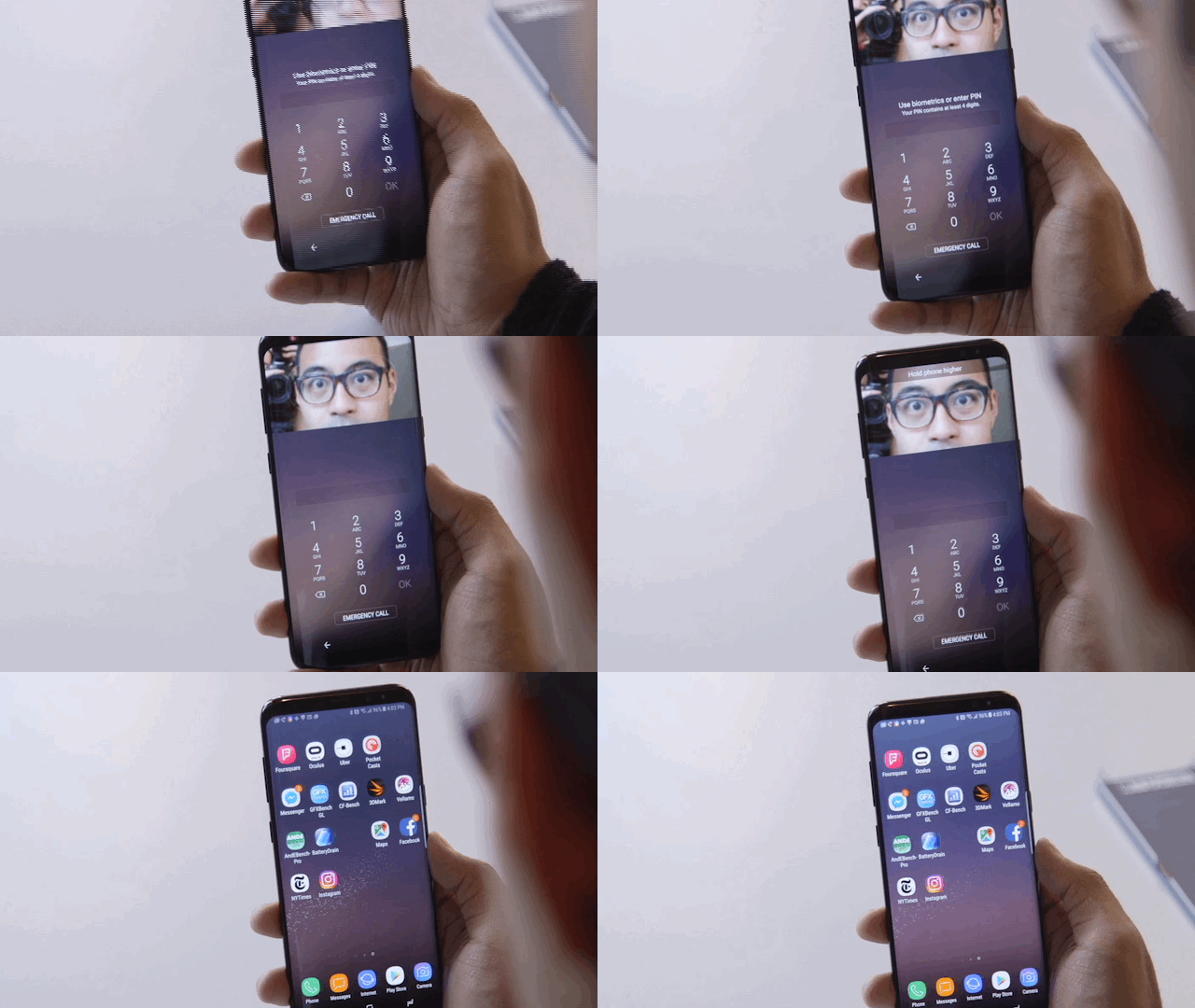
Above the screens are improved, 8-megapixel cameras, and a Note 7-style iris scanner for hands-free unlocking. Most of the time the scanner is fast and frictionless. Often it didn't even show the guide to align your eyes with. Other times I had to open my eyes really wide and move the phone around until I either nailed the alignment or got frustrated and just punched in my PIN.
If PIN codes aren't your thing, there's also the fingerprint sensor on S8 line's back, next to the camera. In prior models, it lived below the screen. I didn't mind the change conceptually, but the placement needs work. The sensor is off center, and a little too easy to miss — I usually smeared fingerprints all over the camera before finding it. And what of that classic home button? It's gone -- your new home button is a pressure-sensitive spot on the screen that vibrates when you push it.
If you're not paying attention, you'd easily miss one of the S8 line's biggest additions: a small button below the volume keys on the phones' left sides. This is what you'll use to invoke Bixby, Samsung's homebrew virtual assistant. The button doesn't do much yet — you'll eventually be able to long-press it to speak directly to Bixby, but for now, it just brings up a screen with upcoming appointments, news and such. Even worse, Samsung has blocked attempts to remap the Bixby key for other functions, which has only pissed off potential power users.
There's a USB-C port on the phones' bottoms, and next to that? The headphone jack. We've seen companies ditching this classic port, claiming that it took up too much space. The S8 and S8 Plus are perfect repudiations of that line of thinking. Oh, and they don't get in the way of waterproofing, either. Both devices are IP68 dust and water-resistant, which meant they could lounge for up to 30 minutes in the ridiculous wine bath we poured.
The stuff inside the S8 and S8 Plus isn't exactly a surprise. Both US models pack Qualcomm's new octa-core Snapdragon 835 chipsets, along with 4GB of LPDDR4 RAM and Adreno 540 GPUs. That horsepower is paired with 64GB of internal storage, and you can add up to 256GB of additional space with a microSD card. In addition to the usual array of LTE and Wi-Fi 802.11 a/b/g/n/ac radios, the S8 and S8 Plus also pack support for Bluetooth 5.0, an updated version of the standard that promises faster data speeds and longer range.
For the people in search of buying advice, here's all you need to know about the S8 and S8 Plus's screens: They're awesome. Thanks for reading.
But seriously, the Super AMOLED panels here are indeed awesome. Color reproduction on both is excellent and, as always, there are different screen modes in case your tastes are more specific. The screens get bright enough to combat the warm spring sun and viewing angles are excellent, too.
Before anything else though, you'll notice that the S8 and S8 Plus screens are longer than most. While many other smartphone screens stick to the 16:9 widescreen aspect ratio, Samsung built the S8 screens with an 18.5:9 aspect ratio. Why? To squeeze more screen into your hand, for one. Beyond that, the length of the screen makes multi-window multitasking — like the kind Nougat natively supports — a breeze. Don't worry, though: Your apps will automatically scale to fit the entire screen, and they'll look damned good in the process. Some videos, meanwhile, will be flanked by black bars since they can't fill the screen. Samsung isn't the first to go this route, though. Rival LG had the same thought when building its G6, which uses an ever-so-slightly shorter 18:9 aspect ratio.
Samsung calls these screens "Infinity Displays," and they run at resolutions as high as 2960x1440 — a little longer than the usual Quad HD. Note that I said, "as high as." The phones are set to run at "Full HD+" — meaning 2220x1080 — by default. You'll need to jump into the devices' settings to coax them into running at full resolution, which is a must when you fire up some Gear VR games. There's also an option to dial down the screen's resolution to "HD+," or 1480x720, in case you need to squeeze as much life out of the battery as possible. The display will set itself to this resolution when you turn on the most aggressive power saving mode, and it's not too bad, either. Icon edges and text look slightly fuzzier, but it's not ugly.
The always-on display is back too, but with a twist. You can customize it further with images in addition to the usual clocks and calendars. Always-on widgets are available now too, if you want to see your calendar appointments or media controls without unlocking the S8. The impact on battery life is negligible, and the sheer amount of customization options can help make your device feel, well, like yours.
Meanwhile, each device has one speaker wedged into its bottom edge, and they pump out loud -- if thin -- audio. They're good enough for podcasts and YouTube videos, but getting the most out of your tunes requires headphones. Good thing, then, that Samsung included a set of AKG earbuds with each S8, and they're leagues ahead of most chintzy pack-ins.
Software
The Galaxy S8 and S8 Plus both ship with Android 7.0 Nougat, but you'd be hard-pressed to tell at a glance. Samsung has once again painted over Google's work. Though, TouchWiz has finally grown up. A lot. Look at the S7's interface: It's full of garish icons and brightly colored circles. The S8's, in contrast, is subtle and thoughtful in its design choices.
For one, the app launcher button is gone — now you just swipe up or down on a homescreen to see everything you've installed. Even better, there's a search bar at the top of the launcher. Managing apps is also easier. Long-pressing an app icon launches a pop-up window with options to add a shortcut to the homescreen, select multiple apps and uninstall or disable the ones you've selected. That last bit is crucial when you're dealing with carrier-mandated bloatware, like the multiple T-Mobile apps on our review unit. In days past, you had to disable uninstallable apps from the device's settings; now you can do it wherever your app icons live

Comments
Post a Comment